
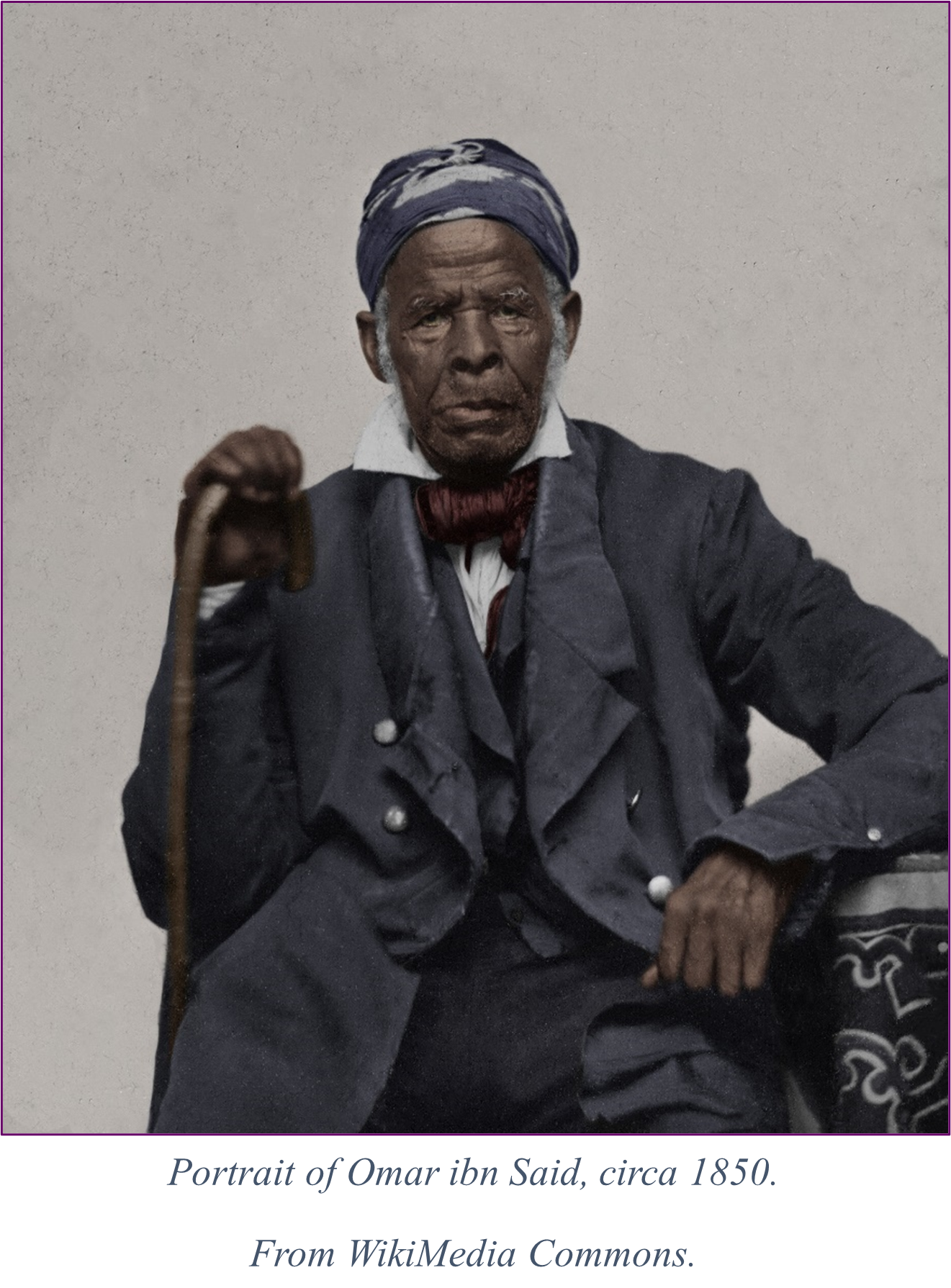
Omar ibn Said’s autobiography, “Oh ye Americans”: The Autobiography of Omar ibn Said, can be read in whole online at https://nationalhumanitiescenter.org/pds/maai/community/text3/religionomaribnsaid.pdf.
This is the original translation from Arabic into English by Isaac Bird, which I find a bit problematic because Bird’s translation is heavily Christian-based. For instance, almost all references to “Allah” he translates as “God,” and thus ibn Said’s voice is lost in the translation.
See also Ala Alryyes, A Muslim American Slave: The Life of Omar Ibn Said (Madison: Univ. of Wisconsin Press, 2011). I find this translation, by a native Arabic speaker, more satisfying. Alryyes also gives invaluable background for ibn Said’s life story.
For a modern translation from Arabic of verses 1–3 of the “Surah Al-Mulk,” see “Quran.com” at https://legacy.quran.com/67.
David Walker’s Appeal can be read in full at https://www.jpanafrican.org/ebooks/eBook%20David%20Walker's%20Appeal.pdf.
For a description of Nat Turner’s Rebellion, see Patrick H. Breen, The Land Shall Be Deluged in Blood: A New History of the Nat Turner Revolt (Oxford: Oxford Univ. Press, 2015).
Court proceedings against the Nat Turner insurrections can be read at “Proceedings on the Southampton Insurrection, Aug–Nov 1831,” at https://web.archive.org/web/20160825053727/http://files.usgwarchives.net/va/southampton/court/ol_nat.txt.
For a brief overview of the American Colonization Society (ACS), see Felix Brenton, “American Colonization Society (1816–1964),” at https://www.blackpast.org/african-american-history/american-colonization-society-1816-1964/. Note that the ACS was not formally dissolved until 1964.
For a compilation of runaway notices, see Arlene Balkansky, “Runaway! Fugitive Slave Ads in Newspapers,” at Library of Congress Blogs, at https://blogs.loc.gov/headlinesandheroes/2019/10/runaway-fugitive-slave-ads-in-newspapers/.
Ibn Said’s autobiographical essay paints a picture of an Islamic scholar toiling away in obscurity and exile. In all, he wrote seventeen tracts while being held in captivity by the family of North Carolina governor Owen, all of them in Arabic. One in particular stands out, the title translated and curated as “Prayers for safe arrival of travelers with the diagram of an amulet.” My first thought upon seeing the title alone was that no West African Islamic scholar of ibn Said’s character would include a mere amulet in a written document. Instead, it would be a symbol imbued with a much deeper spiritual significance simply not understood by modern-day non-Muslim archivists. My reward came upon viewing a copy of ibn Said’s two-page document held at the Library of Congress. Written in his hand, the document contains no such nameless amulet but instead a quincunx: the same symbol that appeared to Benjamin Banneker in a dream, the same symbol that survived the Middle Passage in so many different forms, Islamic and non-Islamic, to become the basis of African resilience and mythology and dance and music and culture and spirituality in the New World down to the present day.
For the complete text in Arabic of ibn Said’s “Prayers for safe arrival of travelers” with his hand-drawn quincunx, see: https://www.loc.gov/resource/amedsaid1831.dw032/?sp=1.
A good overview of the brothers Bilali and Salih Muhammad can be found at the Lowcountry Digital History Initiative. See, for example, “Enslaved and Freed African Muslims: Spiritual Wayfarers in the South and Lowcoutry,” at https://ldhi.library.cofc.edu/exhibits/show/african-muslims-in-the-south/five-african-muslims/salih-bilali-bilali-mohammed.
For Bilali Muhammad’s treatise on sharia, see Muhammad Abdullah al-Ahari, Bilali Muhammad: Muslim Jurisprudist in Antebellum Georgia. (Scotts Valley: CA, CreateSpace Publishing, 2010).
For an overview of Thomas Spalding’s agricultural practices and his dream of a plantation run “without the intervention of any white men,” see Merton E. Coulter, Thomas Spalding of Sapelo (New Orleans: Louisiana State Univ. Press, 1940). Also see Thomas Spalding, “On the Culture, Harvesting and Threshing of Rice, and on the Rust in Cotton,” in Southern Agriculturist, vol. VIII (1835). Available at https://archive.org/details/sim_southern-agriculturist-horticulturist-and-register_1835-04_8_4/mode/2up.
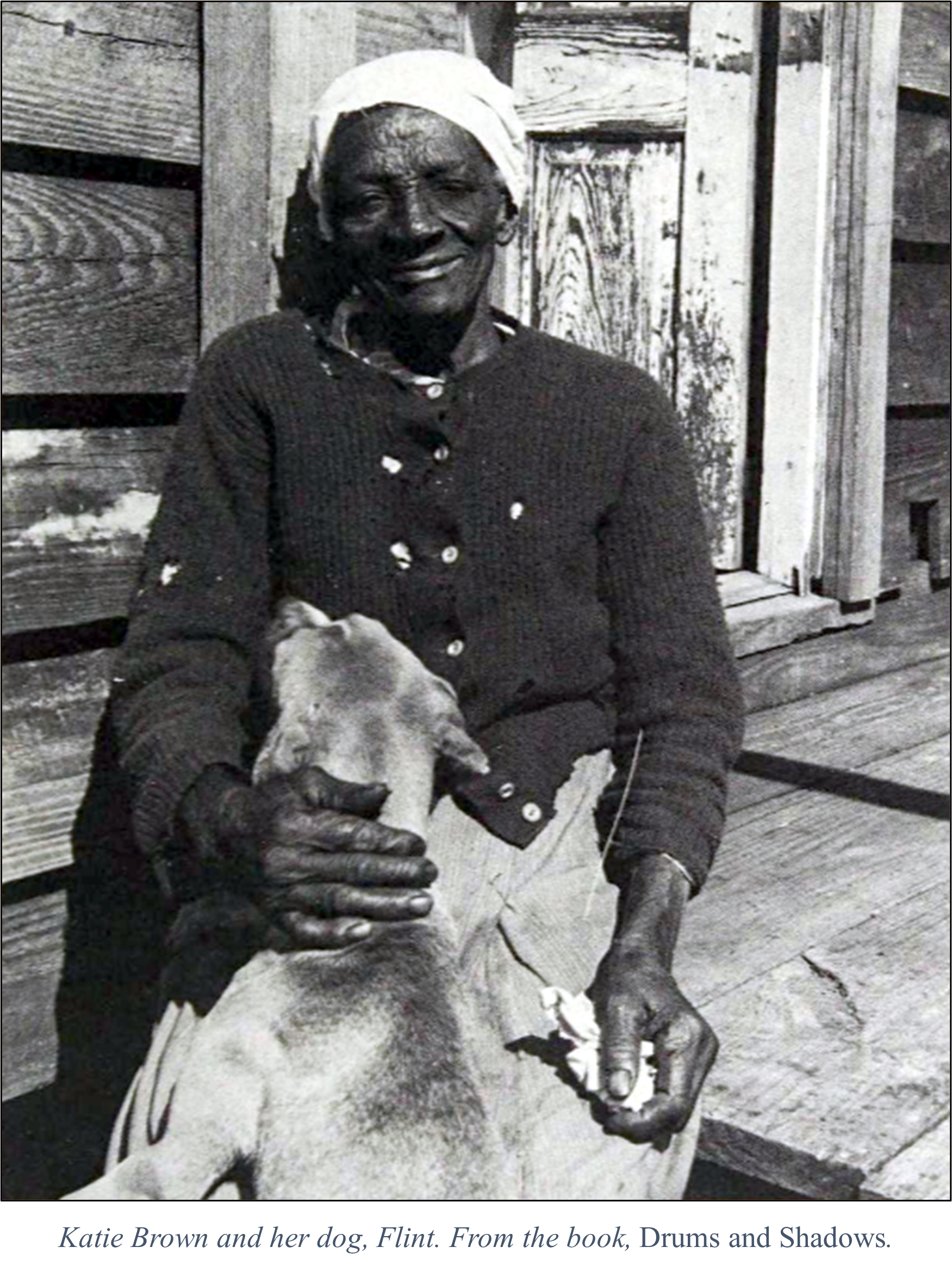
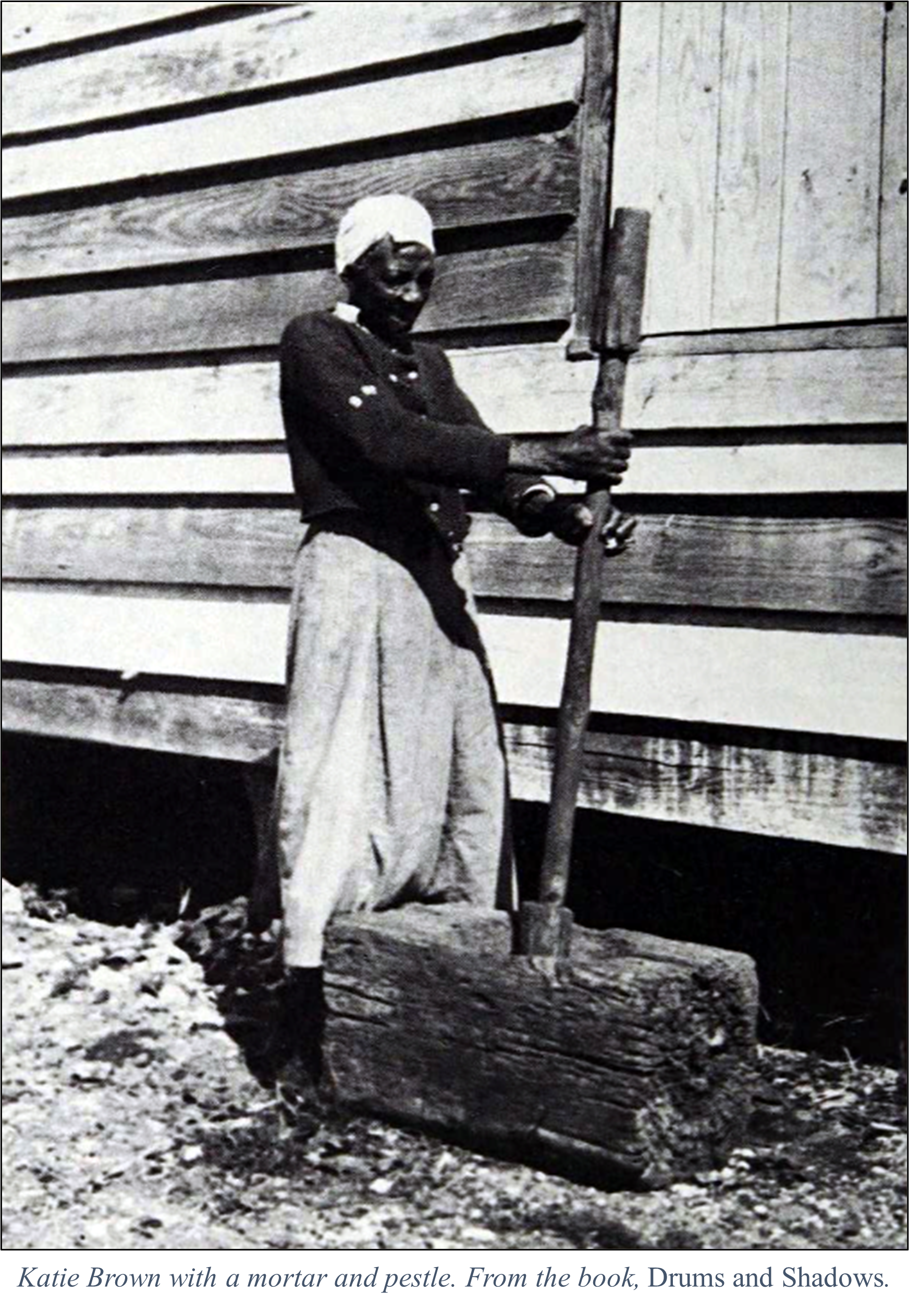
The interviews with Katie Brown are not part of the extensive Federal Writers’ Project now archived by the Library of Congress but were conducted by the State of Georgia’s Georgia Writers’ Project and reprinted in Georgia Writer’s Project. Drums and Shadows: Survival Studies among the Georgia Coastal Negroes. (Athens, GA: Univ. of Georgia Press, 1986).
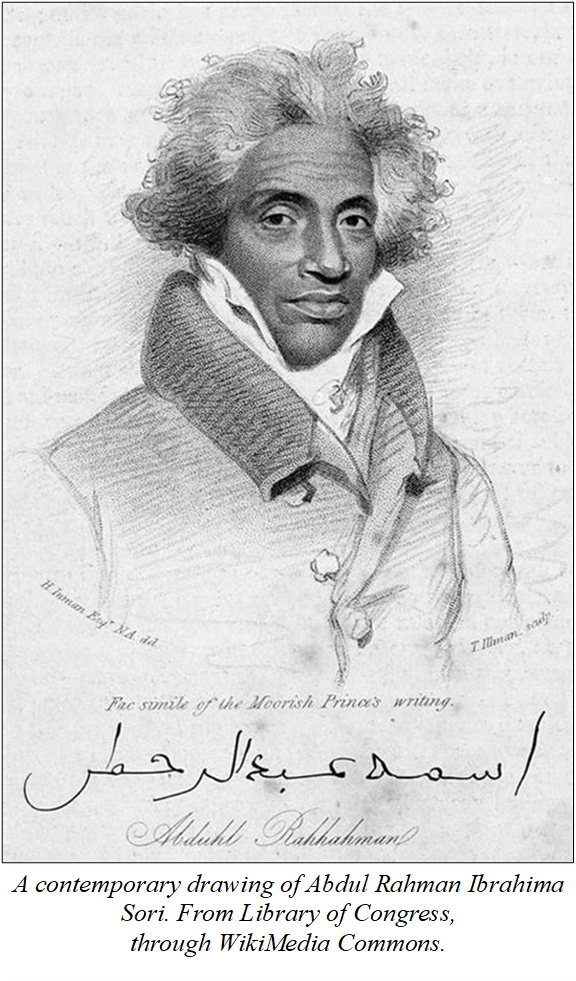
For an overview of Abdul Rahman’s convoluted and ultimately tragic life story, see Dawn Dennis, “Abdul-Rahman Ibrahima,” in the Mississippi Encyclopedia at https://mississippiencyclopedia.org/entries/abdul-rahman-ibrahima/.
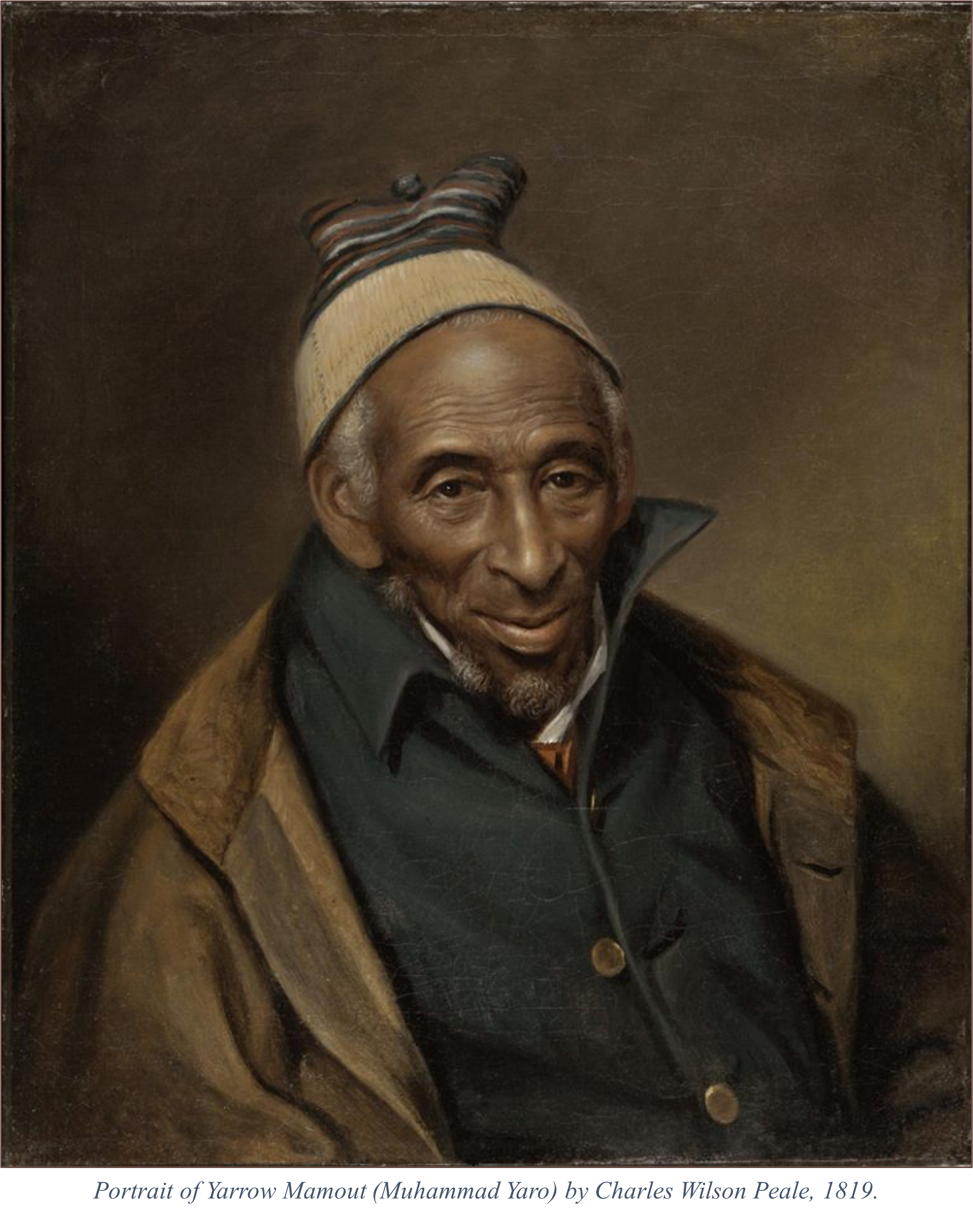
George Washington, Benjamin Franklin, John Hancock, Thomas Jefferson, Alexander Hamilton: Think of any major figure of the American Revolutionary War period and chances are you are conjuring their image from one of the many iconic portraits painted by Charles Willson Peale. But less well known is the portrait Peale did of a formerly enslaved Muslim man named Yarrow Mamout (probably a corruption of Muhammad, Marmoud, Mamadou and Yeru, Yaro, or Yara)—so, Mamadou Yara. His backstory is, by now, sadly familiar. Mamout was Fula, born in the Fouta Djallon region of Guinea, captured and sold into slavery in 1752, then transported to North American aboard the slaver Elijah, where he was sold to a Georgetown planter named Samuel Beall. Mamout was literate in Arabic, maybe somewhat in English. Samuel Beall died in 1777, and Mamout was passed along to his son Brooke, who died in 1796, when Mamout, then sixty, was freed by the Beall family. By then Mamout had accumulated a small sum of money from various jobs, which he worked with the blessings of both father and son. Mamout also invested money in the fledgling Columbia Bank, accruing enough funds that he was able to purchase a Georgetown home at 3324 Dent Place NW.
Charles Willson Peale met Mamout while visiting a Georgetown friend in 1818; the next year he returned to paint Mamout’s portrait. In Peale’s portrait, Mamout’s left eye stares directly at the viewer but his right eye looks off to one side. There’s an almost impish grin and serene countenance in this octogenarian sitting for his portrait. Peale captures incredible detail in the furrows that encompass Mamout’s forehead, traveling down to the upper part of his nose. Mamout is wearing a yellow hat suggesting a traditional Muslim kufi. The curve of his cheek folds and nose complement those of his lips and chin. It has been written that Peale chose to paint Mamout to record the traits that he believed led to a long life and good health; and that he perceived Mamout’s industry, resourcefulness, and sobriety in the face of enslavement and racism, a model of perseverance to be followed. When Mamadou Yara died in 1823, Peale wrote his obituary, which many papers ran.
More on Mamout’s life can be found in Nicole Repersburg, “The Yarrow Mamout Archaeology Project unearths the history of a prominent 1800s African Muslim,” in Creative Exchange, at https://springboardexchange.org/miacarey/.
Also see James H. Johnson, From Slave Ship to Harvard: Yarrow Mamout and the History of an African American Family (NY: Fordham Univ. Press, 2012).